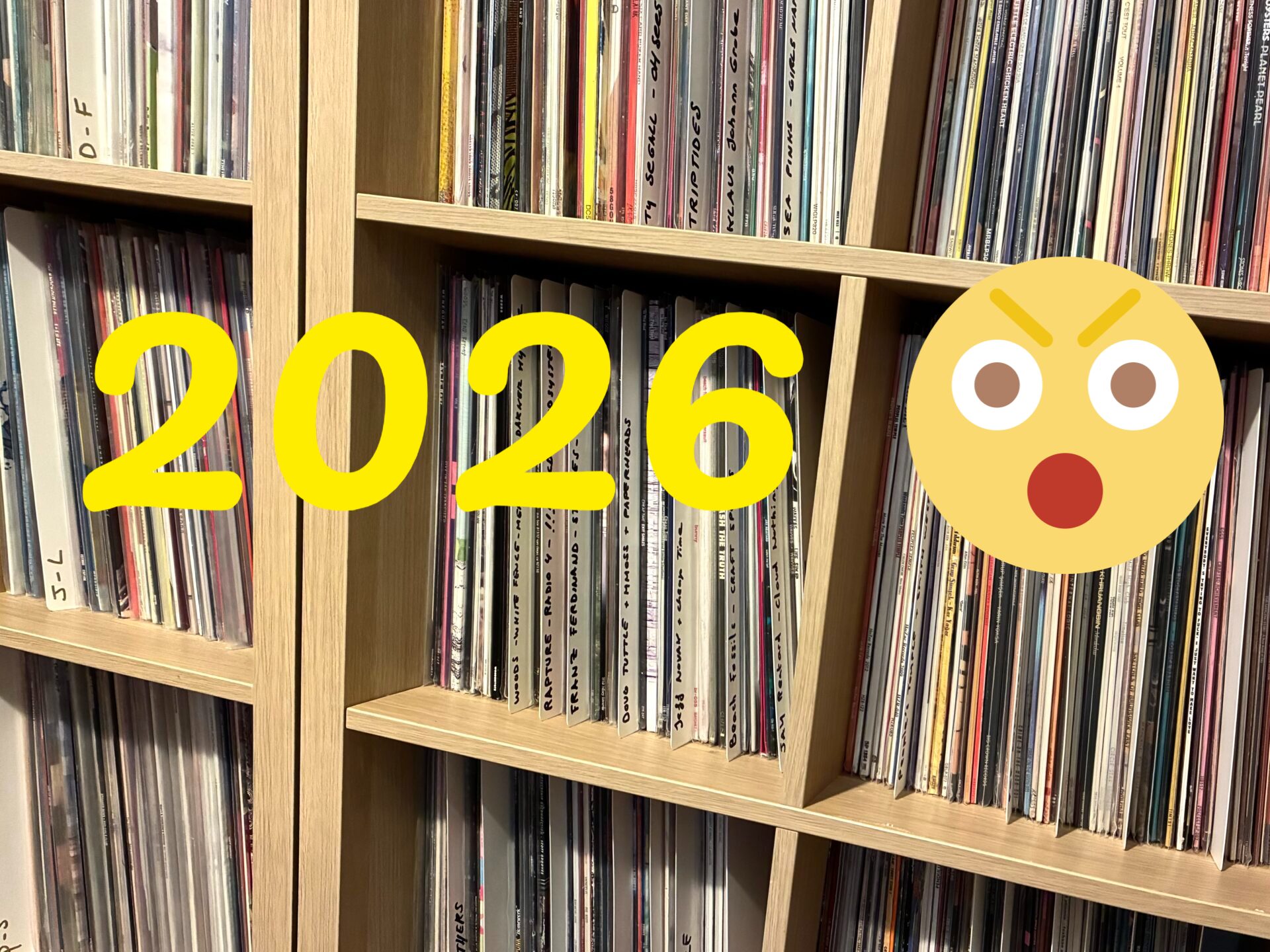
In 2025, there were plenty of reasons to get frustrated with the vinyl revival—whether it was quality issues or vinyl trends we’d love to see disappear. As we kick off 2026, let’s take stock of everything that’s wrong with the vinyl hobby we love so much.
Maybe I’m just an old guy yelling at the clouds, but the vinyl hobby has seriously changed since I got into it back in the 2000s. As a millennial, I don’t always recognize myself in some of the current vinyl trends. I loved the hobby when records were a democratic, accessible thing for everyone. Now the market is clearly shifting toward premium, even if it risks sawing off the branch it’s sitting on.
01 – Endless variants and reissues with bonus tracks
Having a few variants of the same album (indie store exclusive, Bandcamp version, etc.) isn’t a problem. I totally get the strategy of using FOMO to encourage purchases. But like all good things, when it’s done endlessly, it becomes ridiculous. At first, variants were a reasonable tactic to gently boost sales and delight buyers. Over the years, though, it’s turned into a cult-like practice that certain pop stars exploit to sell the same album multiple times to the same person. This kind of fetishism is the complete opposite of what the vinyl hobby should be about.We also need to stop with the “deluxe” reissues that add new tracks. It breaks the logic of the album as a cohesive artistic statement and shared experience. Proliferating versions with different tracklists makes it impossible for a work to be fixed in time. Why not release a separate LP with bonuses like remixes, demos, alternate versions, or live recordings? That would be fine. But don’t treat us like idiots: don’t slap hit singles onto an album that originally lacked them just to juice sales!
02 – Persistent quality issues
It’s not uncommon these days to get a brand-new vinyl that sounds worse than a 40- or 50-year-old record! It’s downright depressing. With vinyl’s resurgence, pressing plants seem overwhelmed and aren’t always paying close attention to what they put out—or maybe the labels themselves are skimping on quality control when approving test pressings? Whatever the cause, the problems are real: warped records, distortion, and audible surface marks on brand-new discs are far too common. I thought this was a fading trend, but 2025 brought me plenty of pressing defects. It’s just too frequent! You’d almost think labels believe people don’t actually play their records at home.
03 – Vinyl prices
This topic keeps coming up online. New vinyl is too expensive, and inflation doesn’t explain everything. Looking back over 20 years, I saw prices stay remarkably stable and reasonable for a long time. A 7-inch single was around €5, a 12-inch maxi about €10, and a full album €15–20. That held true through the 2000s and early 2010s. COVID accounts for part of the current situation, but the upward trend was already underway by the late 2010s. Believe it or not, I paid under €20 for Tame Impala’s Lonerism when it came out. How much was Deadbeat going for in your country a few months ago? I’m guessing €35–40, right?
Here are some examples from my collection (all standard LPs), with original prices adjusted for French inflation:
- Epsilons – Killed ’em Deader – €14.67 in 2011 → €19 adjusted
- Parquet Courts – Wide Awaaaaake! – €20 in 2018 → €24 adjusted
- Parkay Quarts – Content Nausea – €17.76 in 2014 → €22 adjusted
- Parquet Courts – Monastic Living – €19 in 2015 → €23 adjusted
- Fergus & Geronimo – Funky Was the State of Affairs – €15.59 in 2012 → €20 adjusted
- Thee Oh Sees – Drop – €17 in 2014 → €21 adjusted
- Thee Oh Sees – Singles Collection Vol. 3 – €16 in 2014 → €20 adjusted
- Ty Segall – Lemons – €14.50 in 2010 → €19 adjusted
Inflation-adjusted prices fall between €19 and €24, averaging around €21.
Now let’s compare with some recent releases:
- CIVIC – Future Forecast €23
- Autocamper – What Do You Do All Day? €25
- Civic – Chromed Dipped €25
- Lifeguard – Ripped and Torn €27
- Choses Sauvages – III €25
- Youth Sector – Quarrels and Other Grievances €30
- The Tubs – Dead Meat €23
- The Tubs – Cotton Crown – €23
It’s not the fault of these bands or labels—they’re just following the broader vinyl trends in the market. They’re also dealing with rising costs at pressing plants, which are often more interested in churning out the latest Taylor Swift album. That said, these examples are still pretty telling.
The average here is €25 per record, which would have been roughly €21 in 2015 money (or €20 in 2010). That extra €4 per album represents about a 19% markup beyond inflation alone! Over the same period, actual inflation in France was 21.2%, meaning vinyl prices have risen almost twice as fast as inflation ! Today’s prices have basically killed off 7-inch and 12-inch formats.
Maybe prices evolved differently where you live—UK, Canada, US, etc.—but whenever I see US prices posted online or on YouTube, something tells me you’ve all taken the same kind of beating!
04 – The price circus
A direct follow-up to the previous point: I find that prices are a lot less straightforward than they used to be. These days, there’s a much wider spread between new LPs—easily from single to double the price. For example, I paid €37 for one album in 2024 and just €17 for another in 2025—both standard single LPs, brand new, regular editions. It’s not catastrophic, but this pricing scale muddies the perceived value of things.
It’s also a sneaky way for major labels and big artists to grab a bigger share at the expense of smaller artists and independent labels. Not everyone can afford to charge high prices. The ones who do know exactly what they’re doing: they’re pocketing extra margin while less “desirable” releases suffer. Some albums really are a gamble for the passionate buyer, and those records simply can’t demand the same money from customers as mega-stars can.
Back in the 2000s, we didn’t see this kind of price disparity among new releases, whether CDs or vinyl. Everyone was on more or less the same playing field, within a similar price range. Now it’s much harder to pin down what an LP should cost. Is it the traditional price adjusted for inflation—say, $20–25? Yet one quick look at a new-vinyl section is enough to see that prices can shoot up to $40 or even $50!
05 – The premium approach
Too many obi strips, too many reverse-board gatefold sleeves, too many resealable outer sleeves, too many black poly-lined inner sleeves. What we want is well-pressed records, with proper mastering and reasonable prices. This whole premium approach is, on top of that, often superficial (except with niche specialist reissue labels). Having an obi doesn’t guarantee good pressing quality or that the label actually bothered to check the test pressings properly. I’ve had some bitter experiences with that.
I really don’t like this premium direction the vinyl trends is taking. I have a much more democratic vision of the vinyl hobby. Even setting that aside, the premium approach raises questions. While some labels genuinely care about the final product, others clearly don’t put in the same effort. A true premium approach is totally understandable—but only if it comes with zero quality issues. And I’ve noticed that’s definitely not always the case!
06 – Spinning Out of Circulation
This point might not apply where you are. But here’s what I’ve been observing in France and across continental Europe. With the vinyl boom, used records aren’t circulating as freely. People are attaching more value to them now. They’re asking for prices that don’t really match supply and demand. As a result, vinyl records aren’t moving as well, and record stores are struggling to stock up at reasonable prices. Yet second-hand vinyl records are an excellent anti-crisis alternative to the current high prices of new ones. I think in a few years, there’ll be a massive influx of records hitting the market—but they’ll probably arrive too late. Many record stores won’t be around anymore to absorb that supply.
07 – Pre-Orders
Since COVID, pre-ordering has become absolutely everywhere—from museum tickets and restaurant reservations to now pre-ordering records directly on artists’ websites. This practice is genuinely damaging to the entire vinyl ecosystem. On top of that, it helps drive up prices by playing on irrational emotions like FOMO.
Pre-orders represent a double loss for record stores. First, shops are cut out of what would otherwise be straightforward sales. Second, those customers never walk through the door, so they don’t browse the rest of the selection. A record store is an essential link in helping lots of people discover music. As a result, countless additional sales are lost—often on less mainstream, more underground titles.
This tactic, like others (endless variants, inflated pricing), is yet another way to funnel margins back to the big labels and artists rather than sharing them more fairly and sustainably with other players, including smaller labels and artists.
Sometimes these pre-order vinyls don’t even make it to record stores at all! Some labels deliberately press fewer copies than actual demand and have no interest in supplying shops. They actually like the idea of their releases being flipped for higher prices on Discogs. While you can understand the ego boost on a personal level, overall it’s really harmful to the vinyl hobby. Records are meant to be shared, not gatekept. Pressing fewer copies than the market can absorb is a way of turning the passion into something elitist. It’s one of the vinyl trends that pulls us furthest away from the sharing values that are so central to music itself.
08 – The Struggles of Independent Labels
How are independent labels doing these days? In my view, not great. Just a few weeks ago, the Chicago-based label Trouble In Mind announced they were shutting down. To me, that feels like a warning sign of a much more complicated situation. The success of certain vinyl trends shows that the hobby is evolving, sure. The overall market is growing, but is everyone actually benefiting from it? Are the very labels that championed the vinyl revival fifteen years ago—going against the grain of the entire industry—getting at least some of the rewards?
Some labels are getting hit twice over. On one hand, the cost of pressing vinyl records keeps rising, but sales aren’t keeping pace. The market increasingly feels like a winner-take-all game. In any case, there are real reasons to worry about the musical diversity that vinyl is supposed to promote.
09 – The Struggles of Record Stores
In Europe, despite the vinyl trends record stores are in real danger. Many have closed recently: Dust Dealers in Brussels, Discos Revolver in Barcelona, Rhizome in Nancy, Le Silence de la Rue in Paris, Tattoo Records in Naples, and plenty of others. I’m not as familiar with the situation on other continents, but I imagine a lot of them are struggling right now too.
You’d think that with the current success of the vinyl market, record stores would be riding the wave. Yet we’re all seeing it: some are shutting down, others are in tough spots and putting out calls for support on social media. The reasons are straightforward—we’ve even touched on them above: skyrocketing vinyl prices, shrinking purchasing power, pre-orders bypassing shops, and so on.
Let’s remember that when we lose a record store, we’re losing far more than just a brick-and-mortar place that sells records. Going to a record shop means walking out with a new crush, fighting back against algorithms, letting yourself get carried away in the moment. In short, it’s a whole way of experiencing music that so many of us want to defend through this vinyl hobby.
10 – The Lack of Consideration for Physical Distribution
This last point might seem a bit more trivial compared to some of the others vinyl trends we’ve discussed, but it’s still a real concern and something worth keeping an eye on.
I’m deeply attached to physical formats (vinyl and CDs) when it comes to listening to music. In fact, they’re still my main way of experiencing it! Beyond the quality issues and outrageous prices, I’ve noticed that many labels don’t put much active effort into ensuring proper distribution outside their home country.
The rise of streaming and its dominant place in the music industry has led a lot of labels and structures to focus almost entirely on digital distribution, while neglecting traditional physical channels. I recently touched on this too (with the “rust age” of vinyl) when talking about how hard it is for records to circulate beyond those established networks.
For those of us who want to get our hands on these releases, the options are pretty limited: hope the band tours near you, or brave a direct order online if you’re feeling adventurous. It’s genuinely a shame. Personally, I know I’m missing out on releases—and failing to discover others entirely—simply because the records never reach me.
I don’t hold any grudge against labels that genuinely can’t manage wider physical distribution. But some strategies really leave me scratching my head. Certain foreign labels press their records right here in France, yet they don’t bother optimizing physical distribution locally. What’s the point of that?
At the heart of it, there’s a bigger question about the role of vinyl trends today—one that runs through many of my criticisms. Are records still primarily a way to listen to music (with all the ritual that entails), or have they become just collectibles? And you—what about you? Do you see records as part of an artist’s merch line, like a Funko Pop, or as a tangible trace of something that truly moves you deep down?
Related posts:
 45 TOURS: The Dentists « Strawberries are Growing in my Garden (and it’s Wintertime) (Spruck, 1985)
 SHOPPING: 7 et 9 février 2024 à Paris
 French synth-pop (80-85) [Eng]
 Welcome to the Rust Age: Vinyl’s Slow Death [ENG]
 SHOPPING: Achats du 21 et 29 août 2025 à Barcelone (Discos Redondos, Revolver, Paradiso, Vinil Vintage )
 ALBUM: Street Panther « Muscle Rock » (Alien Snatch!, 2024)
 PRATIQUE: comprendre les problèmes de contrôle qualité des vinyles contemporains
 SHOPPING: achats du 12 au 19 décembre 2025
à quand dé post en italiens lol le déballage des cartons se poursuit , 7 perles de coeur de Mr persévérance que je réécoute en boucle , dans ma maisonnette au fin fond de l’Ombrie ou je savoure une quiétude retrouvé loin des turpitudes et de la sinistrose franco française . perseverancevinylique.wordpress.com/2026/01/03/le-deballage-des-cartons-se-poursuit-7-perles-de-coeur-de-mr-perseverance-que-je-reecoute-en-boucle-dans-ma-maisonnette-au-fin-fond-de-lombrie-ou-je-savoure-une-quietude-retrouve-loin-des-turpit/