If rock and electric guitars struggled to make their mark in France, synthesizers gave the country a way to be at the cutting edge of musical trends. Like its German neighbor, France took an early interest in electronic music, whether in a pop register or in more academic circles (IRCAM). In the 1960s, Pierre Henry perfectly embodied the bridge between mainstream audiences and the boldest experiments.
In the 1970s, synthesizers appeared in François de Roubaix‘s film scores and in Jean-Michel Jarre’s novelty hits (pre-Oxygène). Every French household heard these new instruments on television through the jingles and idents of public channels. Progressive rock (Ange, Magma, Heldon, Richard Pinhas) and especially disco — along with its electronic offshoot, space disco — gave French musicians the chance to get comfortable with synthesizers and bring them to a wider audience.
As a result, by the late 1970s France was ripe for the emergence of an free spirit synth-pop scene that had no desire to simply copy its British counterpart. The influences were instead more oriented toward Germany’s Kraftwerk and Japan’s YMO, if any had to be named. These artists thus developed an original, fairly unique sound that was very much its own and distinctly French.
This selection also reflects the decentralized nature of the scene: beyond the obvious hub of Paris, the whole country was dancing to synth-pop! The more underground circles, close to cold wave or gothic aesthetics, built parallel distribution networks thanks to the cassette format.
This selection doesn’t claim to be exhaustive; it’s a more subjective take on a vast subject. Yet it is representative in its own way, since underground bands rub shoulders here with far more popular artists, each using these new technologies in their own distinctive style.
01 – Moderne “Indicatif” (1980, Tours)
Moderne is a band from Tours formed in 1979. The group released two albums in 1980 and 1981 (« Moderne » and « L’espion qui m’aimait »). “Indicatif” (telephone code) is taken from the first record. On that album, Moderne consisted of Gérard Lévy, Thierry Teyssou, Bernard Guimond, and Patrick Millerioux. This track feels like a superb way to kick off this playlist dedicated to French synth-pop. Moderne took their kinship with Kraftwerk so far as to have their albums mixed in the very same studios used for the German band’s early records!
02 – Guerre Froide “Ersatz” (1981, Amiens)
With Guerre Froide, we’re not here to mess around! This cold-wave band from Amiens released, back in the day, a single EP (along with two cassette tapes) that has since been reissued multiple times.
03 – Mylène Farmer “Maman a tord” (1984, Paris)
For this synth-pop selection, I’ve drawn from various scenes of the era. “Maman a Tort” (mom is wrong) Mylène Farmer’s very first single, is a timeless classic and a little gem of the genre. This song directly inspired Mylène’s stage name, since the title was (among other things) a nod to the actress Frances Farmer.
04 – Nini Raviolette “Suis-je Normale” (1980, Paris)
A complete 180-degree turn with Nini Raviolette’s one and only EP. Behind this name is Evelyne Ranaivoarivony, who never released anything else but went on to have a fine career in film editing, particularly for documentaries. While her output was quantitatively modest, “Suis-je normale” (Am i Normal ?) is one of the most beautiful and emblematic tracks of the French underground scene of that era.
05 – Etienne Daho “Jack tu n’es pas un Ange” (1984, Rennes)
Étienne Daho has been one of the key figures in French pop for 45 years. He is closely tied to the Transmusicales festival: he performed at the second edition of this legendary event in Rennes (Brittany). After Mythomane (1981), a debut album produced by Jacno, the Frenchman took a synth-pop turn with his next record — probably his best, or at the very least his most emblematic. The sleeve is just as iconic: it’s a photograph by Pierre et Gilles, visual artists who were hugely famous in France during the 1980s.
06 – Ruth “Polaroïd/Roman/Photo” (1985, Paris)
We’re celebrating the 45th anniversary of Ruth’s album this year. To mark the occasion, Born Bad is reissuing the album with a bonus 7-inch. The disc’s most iconic track is of course “Polaroïd/Roman/Photo,” which you can also find on the Bippp compilation released by Born Bad.
07 – Comix “Touche pas mon sexe” (1981)
Comix is a French duo consisting of André Demay and Natan Hercberg. The former also released a few solo records, while the latter produced several albums in the late 80s/early 90s. Like Ruth’s track, the legendary “Touche pas mon sexe” appears on the Bippp compilation. However, unlike “Polaroïd/Roman/Photo,” the lyrics have a humorous and sarcastic edge.
08 – KaS Product “So Young But So Cold” (1982, Nancy)
KaS Product is one of Nancy’s proudest achievements, Nancy being one of the largest cities in Lorraine (East of France). This duo, formed by singer Mona Soyoc and musician Spatsz, was a leading figure in the French underground scene of the time with their energetic, synthetic punk sound. “So Young But So Cold” perfectly encapsulates the genre in many ways.
09 – Mathématiques Modernes “Paris Tokyo” (1981, Paris)
Let me introduce you to Mathématiques Modernes: two icons of the Palace scene and the “jeunes gens modernes” (modern young people) movement. Among them is Edwige Belmore, whose life would undoubtedly deserve a full-blown novel! Born under difficult circumstances, she found an adoptive family first in the nightlife scene and then among the jet set. She was photographed by the greatest (Pierre et Gilles, Mondino) and walked the runway for Thierry Mugler and Jean Paul Gaultier. Together with her partner Claude Arto, they created Mathématiques Modernes, an album that remains emblematic of the underground French synth-pop of the era.
10 – Mikado “Ce garçon là” (1982, Paris)
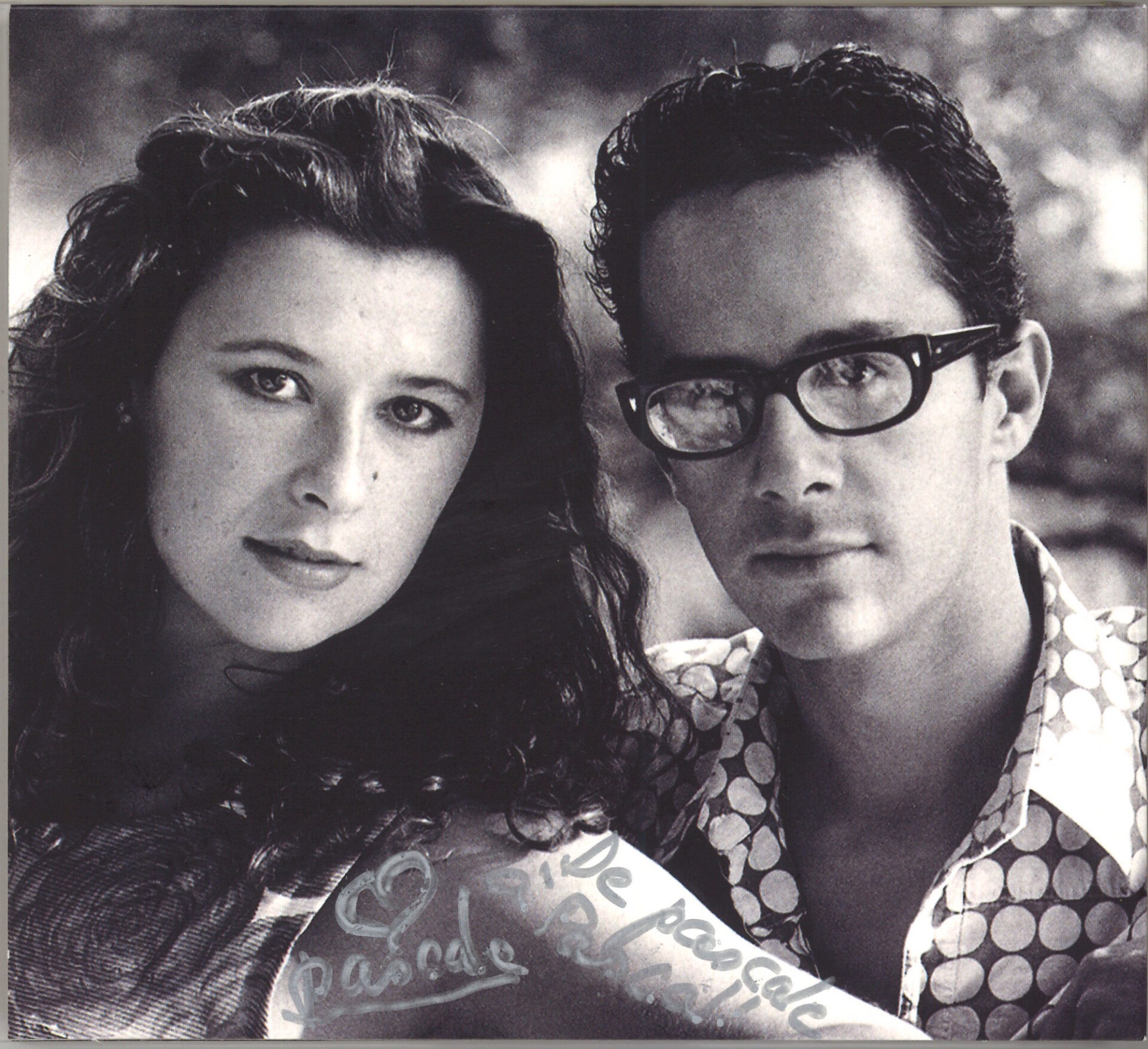
Let’s wrap up this selection dedicated to French synth-pop with another mixed-gender duo — also photographed by Pierre et Gilles: Mikado (pictured in the article). The duo, formed by Gregori Czerkinsky and Pascale Borel, had quite an unusual journey. After a few underground singles that caught attention all the way to Japan, their album was produced by Haruomi Hosono’s Non-Standard label (of YMO fame)! The record eventually got a French-market license through Vogue. The problem? The legendary label was on the verge of bankruptcy and barely promoted this album, which clearly had real potential — as evidenced by the 1986 track “Naufrage en Hiver,” a genuine hit in France. For my part, I’ve chosen an earlier gem from 1982, the excellent “Ce Garçon Là.” Their discography is atypical; Mikado’s lyrics often have a slightly offbeat, humorous yet refined touch. Musically, the duo drew inspiration (among other things) from North American exotica (Yma Sumac, Les Baxter, etc.).
This article is a translation , with a few passages specially rewritten for the occasion (and with a more international perspective), of an article originally published here under the title “PLAYLIST: Synth-pop en France (1980-1985)”.
Related posts:
 PLAYLIST: 10 groupes français des années 60
 45 TOURS: Les Fils de Joie « Adieu Paris » (Dejoie International, 1982)
 45 TOURS: Regrets « Je ne veux pas rentrer chez moi seule » (Philips, 1983)
 PLAYLIST: Nino Ferrer (1966-1969)
 COMPILATION: V/A « O Toi, Beatnik » (Out of Limits, 2000)
 ALBUM: Miel de Montagne « Ouin Ouin » (Délicieuse Records, 2025)
 Welcome to the Rust Age: Vinyl’s Slow Death [ENG]