The Japanese company Roland has been behind countless hits and classics in popular music in all its forms since the 1970s! The company’s instrument engineers have influenced many of the bands you know and love. This story runs through synthesizers (the Juno series) but especially through the legendary TR-808 and TR-909, the spearheads of the TR series that shaped the history of music over the past fifty years.
What exactly is a drum machine?
The TR-808, 909, 707, and others are drum machines, but what is a drum machine, really?
As soon as humans started harnessing electricity, they began thinking of all sorts of applications, especially in communication (like the telephone). In that context, inventors also worked on the very first synthesizers and the very first drum machines. The earliest models date back to the 1930s (the Rhythmicon), but these instruments really took off from the late 1950s onward, and especially during the 1960s — for example, the Korg Mini-Pops in 1967. These early machines were designed for musicians who wanted a steady beat to play along with. That’s why the first drum machines were often bundled with transistor organs. They didn’t let you program your own rhythms; they only offered preset patterns, usually things like samba, foxtrot, waltz, and so on! Even after standalone drum machines appeared, these accompaniment tools didn’t disappear. You can still find that kind of device today for guitarists (the BeatBuddy Mini 2 by Singular Sound or the Korg KR-11, for example).
You had to wait until the mid-1970s to get the first fully programmable, standalone drum machines. Eko (1972) and Gaia (1975) were pioneers, but Roland really made its mark with the legendary CR-78 in 1978. It was quickly adopted by artists like Blondie (“Heart of Glass”) and Orchestral Manoeuvres in the Dark (“Enola Gay”). For the first time, you could program your own rhythms in addition to using the usual presets! It paved the way for Roland’s greatest drum machines in the TR series, especially the TR-808 and TR-909.The programmable drum machine was a revolution. Beyond the classic waltzes and foxtrots, musicians could now create their own original rhythms. Drummers felt threatened, but every inventive musician on the planet suddenly had an incredible new tool at their fingertips.
The original TR
If « TR » is now basically synonymous with the legendary TR-808 and TR-909, the very first models in the series are pretty unremarkable. They were simply responding to what the market wanted at the time: preset rhythm boxes with no way to customize the patterns.Here’s a list (hopefully complete) of those early models and their release years:
- TR-33 (1972)
- TR-55 (1972)
- TR-77 (1972)
- TR-66 (1973)
- TR-330 (1973)
- TR-68 (1975).
After these non-programmable models, Roland dropped the “TR” prefix altogether. The Japanese company shifted its focus to the CR-78 and then the DR series under the Boss brand (Roland’s pedal division). The CR-78 became a true staple of late-1970s drum machines. Besides its presets, it finally let you program your own rhythms, even if doing so felt like you needed a computer science degree! It was tedious and complicated, but still a huge leap forward. By comparison, the DR-55 (1980) was much more bare-bones and rough around the edges, yet just as functional and it definitely found its own audience too.

CR-78 (source).
TR-808 & 606
In 1980, Roland released the legendary TR-808. A year later, the Japanese company put out its little sister, the TR-606, at the same time as the TB-303. These are the only two fully analog programmable drum machines in Roland’s entire TR series. Together they laid the foundations for the iconic line, especially through their super-efficient step sequencer. For the first time, anyone could create their own rhythms in just a few minutes. That system became the standard and was adopted by every subsequent drum machine in the range.
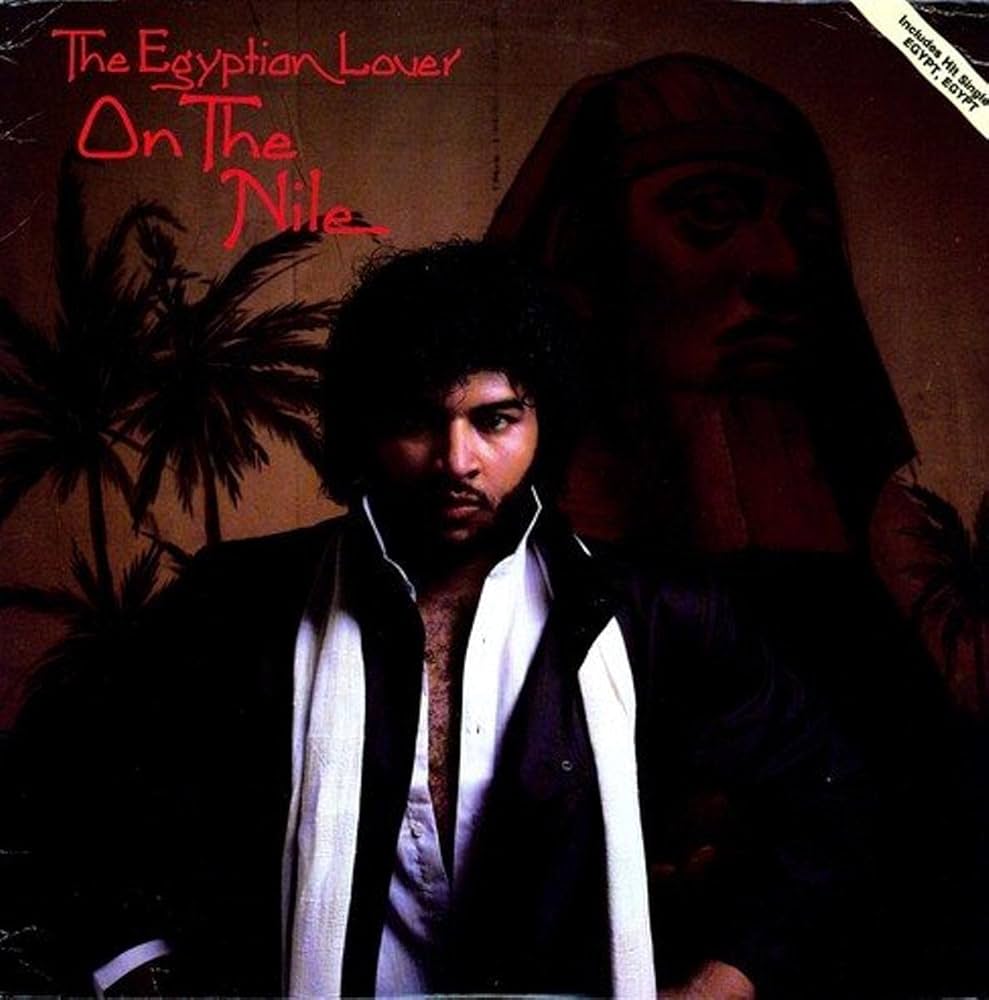
The TR-808 took a decidedly high-end approach. It offers 11 instruments that can be programmed simultaneously (plus a twelfth track for accents). Some of those sounds can be switched to become others: the toms share space with the congas, claves turn into rimshots, maracas become shakers, and so on. It has individual outputs for every instrument, plus dedicated knobs for things like kick decay, snare snap, etc.At first, the TR-808 didn’t really find its audience in mainstream pop productions. Underground producers, on the other hand, welcomed it with open arms. Within a few years it had become an essential tool across many underground genres. You hear it all over italo-disco (Klein & MBO, Alexander Robotnick, etc.), early techno, hip-hop, and late post-disco especially in tracks produced by Jam & Lewis (SOS Band) or Nick Martinelli (Loose Ends). Without question, electro-funk is THE signature genre for the 808. The drum machine is practically mandatory there. From Egyptian Lover to Afrika Bambaataa, everyone swore by Roland’s beast. Its sounds, far removed from acoustic realism, were perfect for driving dancers crazy right up against the club speakers. What the mainstream initially saw as its biggest flaw suddenly became a huge strength in the hands of the era’s most daring producers.
By comparison, the TR-606 feels much lighter and clearly aimed at the home/bedroom market. It’s tiny, has no individual outputs and almost no per-instrument controls (just a single volume knob). You get seven sounds across eight tracks (one accent track and two separate hi-hat tracks for open and closed). Despite its obvious limitations, those dry, bright, aggressive tones are perfect for rock, electroclash, minimal wave, synth-pop, and so on. Whether you buy the original or one or one of the many clones, it remains an affordable drum machine with tons of character and ridiculously easy programming. The American noise-rock band Big Black famously used it, and it also gained a cult following in the IDM/electronica scene Kid606 being a prime example.
Step Sequencer
On Roland TR drum machines, the bar is represented visually right on the front panel. Take the TR-808: one bar is divided into 16 steps, meaning sixteenth-notes (double croches). There’s an LED for each step that you can turn on or off. You select the instrument with a rotary knob, then place the hits by pressing the corresponding step buttons.
On top of this revolutionary yet incredibly simple principle, the TR-808 (and the TR-606) added another brilliant idea: programmable accent. Accent isn’t a sound of its own, but it affects everything else. When you light up an accent on a step, every sound that plays on that step gets hit a bit harder (and often a touch brighter). This is a huge part of what gives these machines their unique, infectious groove.
The step sequencer is an extremely intuitive tool. Its whole loop-based philosophy also perfectly matched the direction music was taking at the time, especially dance music. After the very organic, band-driven disco of the 1970s, dancers were craving something more stripped-down and rhythm-focused. Drum machines like the 808 and 606 answered that call perfectly.
TR-909 (1983)
After the 808 and 606, Roland released the TR-909 in 1983 (or 1984, depending on the source). Like the other TR machines of the 80s, it features the same ultra-efficient programming system, individual outputs (like the 808), and a major new feature: MIDI! Just like the Juno series, the TR line very quickly adopted this brand-new standard. Created in 1983 by Roland, Sequential Circuits, and Oberheim, the Musical Instrument Digital Interface (MIDI) allowed electronic instruments – synths, drum machines, etc. – to talk to each other. Suddenly it became child’s play to run a drum pattern on one machine while triggering an arpeggio on another, even if they were from completely different brands.
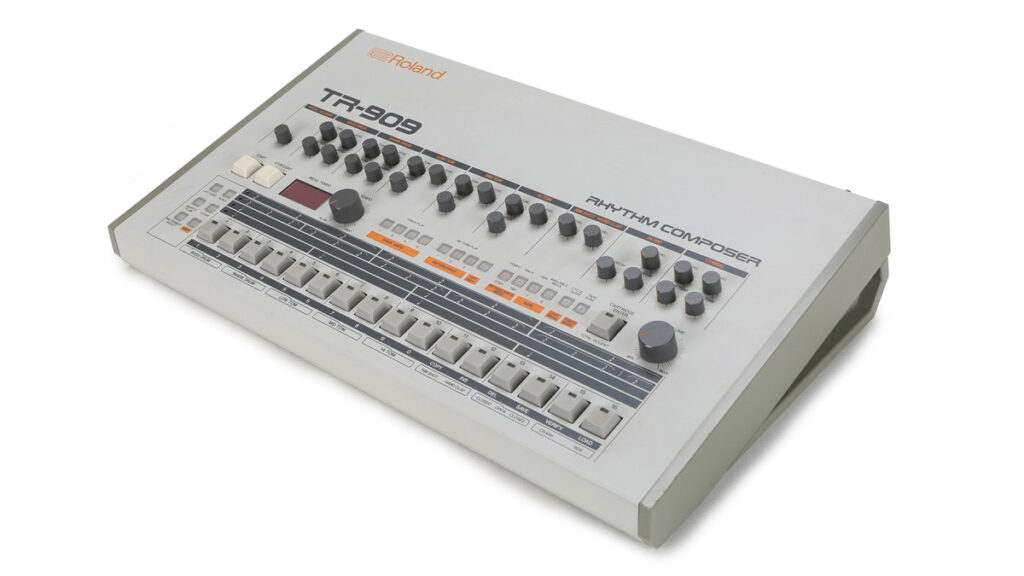
On top of this revolutionary synchronisation, the TR-909 brought another innovation: sampled sounds for certain instruments. It remains the only member of the TR family to combine both technologies. Most of the voices are still analogue, but the hi-hats, ride, and crash cymbals are digital samples. The 909 also made its mark with its famous shuffle (or “swing) function. This shuffle gives the machine a very special, almost human groove that is extremely hard to reproduce with plain samples – it’s one of the model’s most fascinating and distinctive features. It has 11 instruments plus an accent track, and drops some of the more exotic variations like the congas.
Just as iconic as the TR-808, and probably even more widely used, whether in original hardware, clones, or sampled form: the TR-909 is absolutely everywhere in 90s house, techno, acid, eurodance, and beyond. Like its big sister, it was not a big commercial success at the time; only around 10,000 units were made. And, just like the 808, no two 909s sound exactly the same: the sound can vary noticeably from one production batch to another because component tolerances and calibrations weren’t always consistent.
707, 727
The TR-808 and TR-909 both struggled to find a wide audience and remained niche instruments, largely because of their lack of realism. At the time, most producers were looking for drum machines that sounded like a real drummer. In the early 80s, the best way to achieve that was through sampling. However, memory was extremely expensive, so samples were short and used very sparingly.
By the mid-80s, the technology had matured and prices had dropped significantly. In 1985, Roland definitively abandoned analogue sound generation for its drum machines with the release of the TR-707 and its sibling, the TR-727. Both machines are fully digital and built around sampled drum sounds. This came at the cost of most of the hands-on sound-shaping possibilities (decay, tuning, snap, etc.) that the analogue models offered. The 707 has individual faders for level and separate outputs (thankfully), while the rarer 727 is its percussion/latin-focused twin. Though much less common, it’s just as iconic in its own right.
Despite the big technological shift, the core DNA of the TR series remains intact: the step sequencer, accent track, shuffle, and overall layout are all there. Thanks to that familiarity (and a much more “realistic” sounds), the 707 and 727 quickly found their audience. They became huge in house music, especially acid house. You can clearly hear the grain of these Roland machines on the legendary Phuture track “Acid Tracks” – a cornerstone of 90s electronic music that uses the TR-707, TR-727, and TB-303 together. Quite the holy trinity!
Price-wise, both then and now, the TR-707 is far more affordable than the 909. It’s still a cult classic of electronic music, but noticeably less versatile and characterful than its analogue predecessors.
TR-505 and TR-626: the ugly ducklings?
Generally looked down upon, the very last members of the TR family are often ignored by purists. But is that completely fair?
Released in 1986 and 1987 respectively, the TR-505 and TR-626 are of course 100 % digital. Sonically, they’re clearly related to the 707, though I don’t think they use exactly the same sample set.
On the technical side: the 505 has no individual outputs, while the 626 does. The 626 also comes with extra percussion sounds. Even though they’re a little less immediate to program (mainly because Roland ditched the glowing step buttons that made the classic TR sequencers so intuitive), they’re still very straightforward and hassle-free machines.
Their sound, while not as instantly iconic as an 808 or 909, fits perfectly in many contexts: house, italo-disco, minimal wave, boogie etc.
So they remain solid options for anyone who wants a real, hands-on drum machine. Given that both models now sell for roughly the same (very reasonable) price, the TR-626 is almost always the smarter buy: individual outputs, more sounds, and proper trigger outputs (great for firing the arpeggiator on a Juno or SH-101)!
| tech | sync | output | price in EU | |
| TR-808 | analogic | DIN sync + trig | separate | 4500€ |
| TR-606 | analogic | DIN sync + trig | mono | 450€ |
| TR-909 | both | MIDI + trig | separate | 4000€ |
| TR-707 | digital | MIDI + trig | separate | 500€ |
| TR-727 | digital | MIDI + trig | separate | 800€ |
| TR-505 | digital | MIDI | stereo out | 150€ |
| TR-626 | digital | MIDI + trig | separate | 150€ |
The prices indicated for used units reflect the French market and will be fairly similar across the European Union. It is possible that the most prestigious models (TR-808 and TR-909) are worth more in the United States or in the United Kingdom.
Legendary Songs Built on the 808 and 909
808 State – Pacific State [TR-909].
It’s pretty ironic: « Pacific State » by 808 State actually features a TR-909. This British track from the late ’80s (1989) was played during the final months of the Haçienda before making its way to Ibiza. Within just a few months, it became a true dance music classic. The bird sample (a loon call) has also become such a staple that it even ended up being sampled by Lady Gaga.
A Guy Called Gerald – Voodoo Ray [TR-808].
England, the same era—and even more so! Gerald Simpson, professionally known as A Guy Called Gerald, was a founding member of 808 State. What’s more, he reportedly contributed significantly to their classic « Pacific State » before leaving the group. Regardless of the ongoing debate over his exact involvement in the track, A Guy Called Gerald also proved he was a force to be reckoned with on his own, thanks to the timeless « Voodoo Ray. »
Loose Ends – Hangin’ on a String [TR-808]
The TR-808 didn’t have to wait for house and techno to become a staple in dance music. Back in 1985, the Brit funk/soul group Loose Ends topped the Billboard R&B chart—an unprecedented feat for a UK act at the time! Nick Martinelli’s production played no small part in that success; it’s so emblematic of the era and absolutely masterful. A track that’s still just as brilliant forty years later.
Adamski – Killer [TR-909]
In 1990, DJ and producer Adamski topped the UK charts with the classic « Killer. » The song also introduced the world to singer Seal, whose career skyrocketed throughout that incredible decade. Originally, the track was just an instrumental. But fate had other plans: on New Year’s Eve 1989, Adamski and Seal crossed paths at a club. A few weeks later, the singer laid down his vocals—in one single take. And it was perfect!
Afrika Bambaataa & The Soul Sonic Force – Planet Rock [TR-808]
After the UK, let’s talk a bit about the United States. Roland’s Japanese machines also found an eager audience there among the most forward-thinking dance music producers. Arthur Baker and John Robie were the masterminds behind this classic by Afrika Bambaataa & The Soulsonic Force. The preacher of the Universal Zulu Nation came up with the idea for the track during his famous block parties in the Bronx. Indeed, « Planet Rock » draws freely from two classics beloved by DJs of the era: « Numbers » and « Trans-Europe Express » by the German group Kraftwerk.
S.O.S. Band – Just be Good to Me [TR-808]
Electro-funk, but also boogie. Prince’s former protégés, Jimmy Jam & Terry Lewis, set dancefloors on fire with the incredible « Just Be Good To Me » by The S.O.S. Band. While the track didn’t hit number one on the US charts, it was a massive success in Europe—especially in the Netherlands, Belgium, the UK, and Ireland. A few years later, it got a second life when Norman Cook (aka Fatboy Slim, from The Housemartins) gave it a genetically modified makeover, blending it with « The Guns of Brixton » by The Clash!
Mr. Fingers – Can You Feel It [TR-909]
No matter which version of « Can You Feel It » you’re talking about (instrumental, vocal, or the one with the speech sample), Mr. Fingers’ track is an absolute staple of Chicago house. Above all, it’s a masterpiece of production—minimal yet incredibly elegant. The TR-909 fits right in naturally, with a gorgeous use of its ride cymbal.
Schoolly D – P.S.K. « What does it mean? » [TR-909]
Traditionally, the TR-909 is the go-to machine for house producers, while the 808 has way more street cred in hip-hop. Forget all your preconceptions—just listen to Schoolly D absolutely taming this completely insane and over-the-top powerful TR-909 beat.
Mantronix – Bassline [TR-909 + TB-303]
909 and 303: a Hardfloor track? Nope, another legendary American rapper: Mantronix. That bassline grabs you by the collar and proceeds to blow your mind. From a historical perspective, this track is fascinating because such a straightforward use of the Roland bassline is ultimately pretty rare!
Marvin Gaye – Sexual Healing [TR-808]
Let’s wrap up this selection dedicated to Roland TR machines with Marvin Gaye’s « Sexual Healing. » In the early ’80s, the African-American singer was physically and mentally exhausted. Struggling with cocaine addiction and deep depression, he headed to Ostend in Belgium for a while, at the invitation of a concert promoter and nightclub owner named Freddy Cousaert, to get his health back on track. There, he rediscovered his zest for life and wrote the last great hit of his career: « Sexual Healing. » The song simply wouldn’t be the same without that utterly distinctive TR-808 beat driving it forward. Marvin Gaye stumbled upon the drum machine in the studio where he recorded the album—a place called Katy, named after the hit song by Marc Aryan. What a great Belgian story!
808, 909, a 21st century odyssey
Are Roland TR drum machines still popular today? Let’s not keep you in suspense: yes, absolutely. Sure, we’ve heard those 909 hi-hats or the 808 cowbell a million times—and so what? They’ve become true classics, timeless and immortal. Beyond the original machines themselves, they’ve been sampled and resampled endlessly. These days, the 808 has even become a staple in trap music, used as a bassline. On top of that, you can find digital reissues (from Roland) or analog clones (like those from Behringer) on the market. Besides appealing to nostalgic fans, there’s no doubt that clever young producers will keep finding fresh, exciting ways to use them. Long live the TR-808 and TR-909!