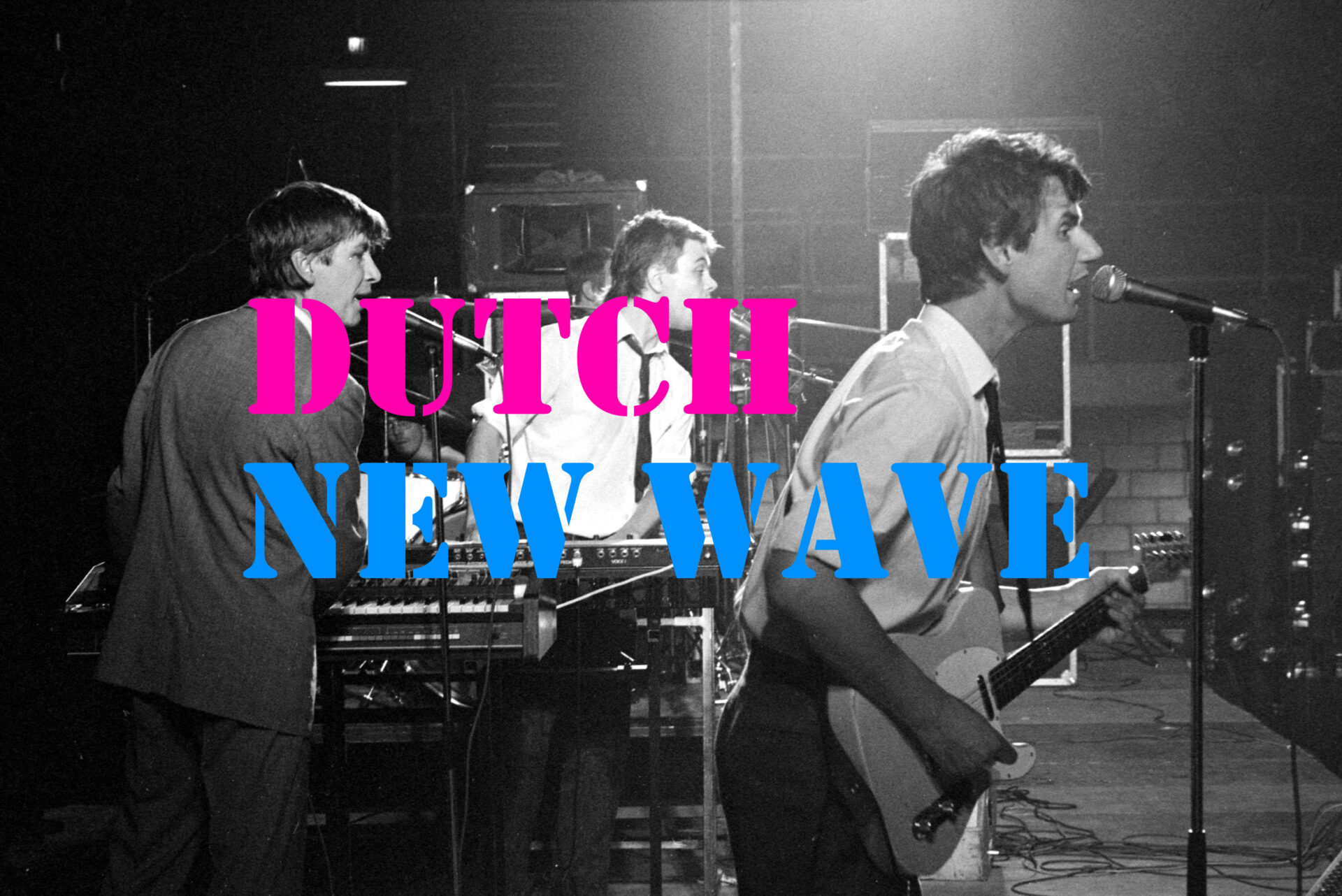
As early as the 1960s, the Netherlands developed an interesting rock scene through beat music. The country built a strong underground scene (hard rock, prog, etc.) in the early 1970s, but the punk wave shook everything up. In the Netherlands, bands like Ivy Green, The Ex, and Flyin’ Spiderz (who released the first Dutch punk album in 1977) made a lot of noise and paved the way for a wide variety of musical styles.
In the underground scene, the term Ultra (short for ultramodernen – ultra modern) was often used to describe the post-punk and experimental bands from Amsterdam at the time, notably Mekanik Kommando and Minny Pops. The latter even had the honor of being signed to Factory Benelux!
While the underground was buzzing, the Netherlands was dancing and grooving to the sounds of Doe Maar or Herman Brood & His Wild Romance. Following in the footsteps of The Police, Madness, or The Specials, the former explored the skank of reggae and ska with Dutch-language lyrics (quite rare in Dutch rock, even during the new wave period). Herman Brood, for his part, was almost a Christ-like rock figure among the Dutch. He started his career in the 1960s, even played in Cuby & The Blizzards, but really made a name for himself in the late 1970s. He developed a straightforward rock sound with a lot of attitude. More than new wave, his music drew from the pub rock of bands and artists like Dr. Feelgood, Little Bob, or Willie “Loco” Alexander.
This new wave playlist dedicated to the Netherlands doesn’t aim to be exhaustive. It’s based on my personal tastes and my passion for powerpop and, more generally, melodic bands! I tried to select tracks where organic instruments, especially the drums, take center stage.
01 – The Nits “A to B; C to D” (1979, Amsterdam)
The Nits share some similarities with XTC in their journey. Like the Swindon group, our Dutch friends love the Beatles and angular pop. Like XTC, they sometimes overdo it — but that’s also why we love them! In any case, Tent, their first album for CBS (their second overall) is a little gem of sophistication. It’s surprising that the band’s recognition remains so limited to just a few countries (Benelux, France).
02 – Gruppo Sportivo “My Old Cortina” (1980, The Hague)
Gruppo Sportivo is one of the most popular Dutch new wave bands both at home and abroad. They even received coverage in the English press! Formed in The Hague in 1976, they scored an early major hit with the single Disco Really Made It. In quick succession, Gruppo Sportivo released several classics such as 10 Mistakes (1977) and Back To 78 (1978). “My Old Cortina” comes from their fourth album, Pop! Goes The Brain, released in 1981. Even though the band’s commercial success was starting to fade, their inspiration certainly wasn’t — this song is a delightful pop pearl that still holds up beautifully.
03 – The Meteors “Blitzkrieg” (1979, Amsterdam)
The Meteors (not to be confused with the British psychobilly band of the same name) were a Dutch new wave band with new romantic and even powerpop touches. The vocals might remind you of David Bowie or Iggy Pop! “Blitzkrieg” explores the most melodic side of The Meteors. The band released three albums between 1979 and 1982 and appeared in the cult film Cha Cha.
04 – The Rousers “Magazine Girl” (1979, Broek op Langedijk)
Careful — here’s a real hidden gem that’s hard to find, even in Amsterdam record stores! A Treat of New Beat (1980) is the debut album by the powerpop band The Rousers. It’s an ultra-effective and super-catchy record in the vein of British bands like Buzzcocks, The Keys, The Freshies, or The Donkeys. To top it all off, the cover was designed by the master of clear line art: Joost Swarte. He also created several covers for the funk band Houseband.
05 – The Mo “Fred Astaire” (1980)
There isn’t much information available about The Mo. They released three albums between 1980 and 1984 and scored a few hits, including “Fred Astaire”. A fun detail: the band had no guitar, but a bassoon instead! The Mo also made heavy use of the Wurlitzer electric piano, which gave them a very distinctive sound. Nevertheless, their post-punk-tinged pop is incredibly charming and unique.
06 – Het Goede Doel “België” (1982, Utrecht)
It’s quite funny to think that one of the hits by this Dutch band is called “België” (Belgium)! In 2015, the song sparked controversy when a far-right politician tried to use it for his campaign, much to the band’s dismay — they naturally blocked its use. Unlike many Dutch bands, Het Goede Doel sang in Dutch, and I think that adds to the charm of this track. It reminds me of other European groups like Herois Do Mar (Portugal) or the great Tino Casal (Spain).
07 – Urban Heroes “Get it” (1980, The Hague)
Urban Heroes was a new wave band from The Hague. They released two albums and a live record before temporarily splitting up. Some members then formed Boom Boom Mancini. The band later reformed and released more albums in the late 1980s and 1990s.
08 – deDIV “Stap Voor Stap” (1981, Delft)
The band deDIV had the distinctive feature of singing in Dutch — a fairly rare and courageous choice, as evidenced by this selection. They delivered a highly successful angular post-punk sound, comparable to groups like A Certain Ratio. In the mid-1980s they moved to Brussels and were produced by Jean-Marie Aerts of TC Matic.
09 – The Tapes “Into Action” (1980, Amsterdam)
This Amsterdam band released three albums between 1978 and 1981. “Into Action” is taken from their second album. You can clearly feel the influence of post-punk and new wave groups like XTC in its frenetic and disjointed feel. Very intriguing!
10 – Toontje Lager “Stiekem Gedanst” (1983)
Toontje Lager is one of the most popular Dutch bands of the period, even if their success doesn’t quite match that of Doe Maar. Their music is actually quite similar, also influenced by ska but in a slightly more subtle way. The group formed in 1978 and released their first album in 1980, but it was their second record that really brought them major success. “Stiekem Gedanst” (Secret Dancing) is one of the biggest hits of their career and appears on their third album in 1983.
This article is a translation of that playlist: New Wave aux Pays-Bas.
Related posts:
 PLAYLIST: New Wave aux Pays Bas (1979-1983)
 PLAYLIST: Rod Temperton
 PLAYLIST: (Power)Pop au Royaume Uni (1977-1981)
 COMPILATION: Pushups « Pushups is Pop » (Hozac Archival, 2021)
 PLAYLIST: James Mtume & Reggie Lucas
 PLAYLIST: New Wave Funk (1980-1983)
 PLAYLIST: Powerpop en France (1980-1984)
 PLAYLIST: Ciné Cinéma #2 (1979-1986)